Montana Elk Hunting: A First-Timer's Guide
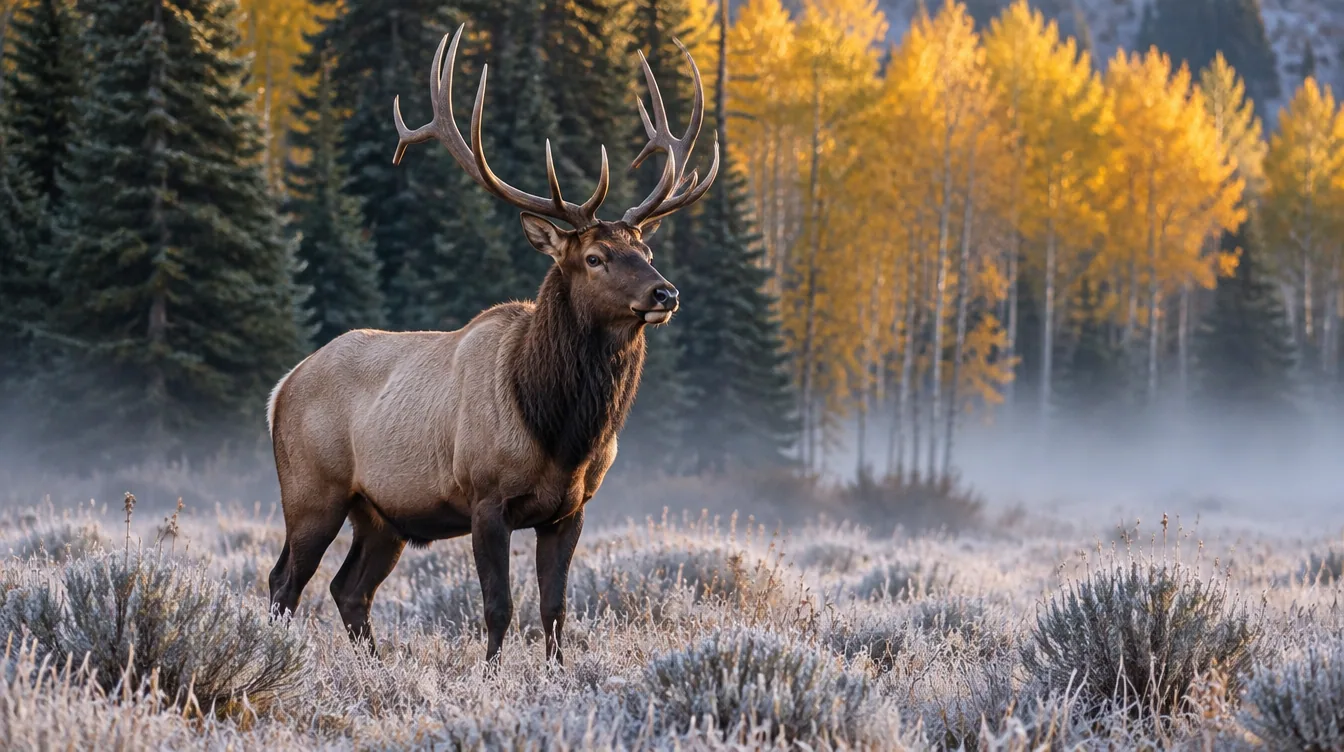
You heard one bugle once, and it stayed with you. A bull screamed somewhere back in the black timber, the sound went through your chest instead of your ears, and you understood in about four seconds why grown men plan whole years around a single week in the mountains. Now you are holding a decision that costs real money. A nonresident Montana elk license runs $1,112 for the Elk Combination, and $1,312 for the Big Game Combination. You have ten days off work, a truck, and no idea which unit deserves them.
That gap between the feeling and the logistics is the whole problem, and it is the reason most first Montana elk trips underperform. Not because Montana is short on elk — the state has plenty. The trouble is that Montana hands you a rulebook and a map, then wishes you luck. Nobody sits you down to explain which tag you can actually get this year, which country holds animals you can physically reach, and what the trip will take out of your legs and your wallet.
So here is that conversation, in order, with the numbers attached. Nothing below is a unit you will never draw, and none of it is outfitter marketing. It is how the system works, and what a real first trip looks like once you stop dreaming and start planning.
The quick facts (Montana elk, 2026)
Every figure below carries its year, because FWP resets the seasons and the deadlines annually. Re-verify each of these against the current regulations before you buy anything.
| Archery season | Sep 5 – Oct 18, 2026 |
| General rifle season | Oct 24 – Nov 29, 2026 |
| Muzzleloader season | Dec 12 – Dec 20, 2026 |
| Resident tag | General elk license over the counter, $20 ($10 senior/youth) |
| Nonresident tag | Draw a Combination: Elk $1,112 · Big Game, deer and elk, $1,312 · Deer $760 |
| Application window | Mar 1 – Apr 1, 2026; draw results mid-April |
| Where they live | "Widely distributed in forested and rugged areas… increasing in abundance in eastern regions" (FWP Field Guide) |
| Open ground | About 80% of the state is open to general-tag hunting (FWP, 2022) |
| Rough difficulty | Residents walk in and buy. Most nonresidents must draw a Combination, and the marquee limited permits are far harder than that. |
Two things about the nonresident Combination are worth saying plainly. Each one includes general deer and/or elk, upland game bird except turkey, and a season fishing license, so the price buys more than a single animal. And you may hold exactly one Combination per nonresident per year. On top of the Combination, every hunter needs a Conservation License and a Base Hunting License, which for a nonresident adds $10 and $50.
Where Montana elk actually live
FWP's Field Guide compresses the whole range into one honest line: elk are "widely distributed in forested and rugged areas… increasing in abundance in eastern regions." Read that sentence twice, because it tells you two useful things at once. Elk are not a western-Montana animal only; they are a Montana animal, and every one of the state's seven FWP regions holds them. And the growth is happening in the east, which matters to anyone building points for the long game.
Montana runs seven administrative regions, numbered 1 through 7, each with its own regional office. A hunting district's number matches its region, so a 300-series district sits in Region 3 and a 700-series district sits in Region 7. That convention is the fastest way to read a Montana map, and it is worth committing to memory before you look at a single unit.
Not every one of those seven regions deserves your first trip equally, so tier them by how much elk country each one actually offers.
Core country — where the elk hunting is deepest. The southwest is the heart of it. Region 3, out of Bozeman, holds the Gallatin, Madison, and Gravelly elk herds, and it is the country most first-timers picture when they picture Montana elk. West of it, Region 2 out of Missoula covers the Bitterroot and the Clark Fork, a broad country of forested ridges and long drainages that soaks up pressure better than its reputation suggests. Northwest of that, Region 1 out of Kalispell covers Flathead and Kootenai country, the wet, thick, big-timber side of the state where elk behave differently and the cover rarely ends.
Present, and rising — the tier you should watch. Region 4 out of Great Falls carries the Missouri Breaks, which spans Regions 4 and 6 and gives the state one of its strangest elk landscapes, broken badlands instead of alpine timber. FWP names district 700, the Missouri Breaks–Prairie, among the state's hunting districts, so that country is a real unit on the map rather than a rumor. Region 6 out of Glasgow and Region 7 out of Miles City hold the eastern range where FWP reports the abundance increasing, and Region 5 out of Billings rounds out the east along the Yellowstone valley. These are not consolation prizes; they are where a hunter who reads the trend instead of the folklore might be hunting in ten years.
For a first trip, the practical rule is simple. Hunt the core if you can get the tag and handle the country, and treat the eastern regions as a live option rather than a last resort.
The tag: draw or general
This is the fork that decides your entire year, and most first-timers get it backwards by assuming the tag is the hard part. It is not, because the tag is only the gate.
For a Montana resident, there is no gate at all. A general elk license is sold over the counter for $20, and a resident may hold up to three elk licenses in a year, one of them general. Resident hunting in Montana is one of the most accessible setups in the West.
For a nonresident, the gate is real. You cannot buy a general elk license across the counter. You draw a Combination, and the three flavors are the Elk Combination at $1,112, the Big Game Combination at $1,312, and the Deer Combination at $760. Applications run Mar 1 through Apr 1, 2026, with results in mid-April. Only one Combination per nonresident per year, so the choice of which one you apply for is a year-long commitment.
The Combination drawing runs on preference points, and this is the part people confuse. Three-quarters of those licenses go out in preference-point order. The remaining quarter goes into a random draw among applicants holding zero points. Preference points cap at three, cost $100 each, are lost if you skip a year, and are used up the moment you draw. If you are building toward a Combination, you are not building a decade-long tower. You are buying a short, finite ramp.
Bonus points are a different animal, and they apply to the limited-entry elk permits rather than the Combination. Bonus points are squared before the draw, which means they behave like extra raffle tickets rather than a queue. FWP's own example makes it concrete: ten points becomes (10 × 10) + 1, or 101 entries. One bonus point may be bought per license year per permit type, and they accumulate until you draw. The mechanics are worth reading closely on our bonus points page, because that squaring is what actually changes your odds.
Parties are allowed up to five hunters together, and the party uses the average of its members' points. The whole party gets one entry, so grouping up is a smoothing move rather than a multiplying one. It helps a mixed group of veterans and newcomers, and it does nothing for five hunters holding identical points.
There are routes around the front door, and a few of them are genuinely useful. Leftover licenses go up for sign-up Jun 15 through Jul 15, and whatever survives that goes over the counter. Returned nonresident Combinations are handed out through the Alternates List between May 1 and Jun 1, with availability peaking in early fall. Former Montana residents have Come Home to Hunt, at $656 for the Big Game Combination, $556 for elk, and $380 for deer, with a quota of 500 in each category and the same Mar 1 – Apr 1 window. And anyone born in Montana can get the Nonresident Native License at those same prices, unlimited and over the counter.
One route sits on the landowner side, and it explains why some quotas look smaller than the map suggests. Landowner Preference reserves 15% of a district's quota, and for elk the landowner needs at least 640 contiguous acres to qualify. It is not a shortcut most hunters can use, but it is part of why a unit's available tags rarely match the acreage you see on a screen.
If you want a first trip without burning years, look at Elk B. Those are generally antlerless tags, sold by drawing and sometimes over the counter. A resident pays $25 in the draw or $20 over the counter; a nonresident pays $275 or $270. Many Elk B antlerless drawings run at double-digit success rates, which makes them the most realistic way to learn Montana elk country with a tag in your pocket. The full walkthrough lives on our guide to applying for a Montana elk tag.
What a first elk trip really takes
Four things decide whether your trip works. You need a unit you can actually reach, land you are legally allowed to be on, a scouting plan built before you leave home, and a season window that fits your calendar. Get those right and the hunting takes care of itself. Get them wrong and no amount of gear saves you.
Unit choice: pick the unit before you pick the bullet. The unit determines your access, your pressure, your drive time, and how much of the season you can realistically use. A unit you can hunt for nine days beats a better unit you can hunt for two.
Access: this is where Montana rewards homework, and it is where most of your trip is won or lost. The state holds more than 30 million acres of state and federal land, nearly a third of Montana. The U.S. Forest Service manages roughly 16 million acres across the Kootenai, Flathead, Lolo, Helena–Lewis & Clark, Beaverhead–Deerlodge, Bitterroot, and Custer Gallatin forests. The BLM holds about 8.3 million acres of that, spread across the plains and the breaks. State school trust lands add about 5.5 million acres, and those require a Conservation License to hunt.
Then there is Block Management, the program that opens private ground to public hunting at no charge. In 2025 it enrolled 1,326 cooperating landowners across 6.81 million acres and paid out $12.5 million. Those numbers move every year, so check the current season's figure rather than trusting a number you read on a forum. FWP publishes its Hunter Access Guide by Aug 15, and our explainer on Block Management covers how sign-in and the boundaries work.
One rule has no exceptions: on private land, every hunter must have landowner permission, whether or not the property is posted. Montana holds a lot of private ground, and that is exactly why the access programs exist.
Scouting: you are not hunting a state; you are hunting a drainage. Learn one unit well, down to the trails in, the glassing points, the water, and the bedding cover, and you will out-hunt a better-prepared stranger in a better unit. Distance scouting before the trip beats improvisation during it.
Timing: the archery window, Sep 5 – Oct 18, 2026, is when bulls are most likely to answer a call, and it asks for patience, wind discipline, and close work. The general rifle season, Oct 24 – Nov 29, 2026, opens after most of that talking is over, and it asks for glassing, distance, and an understanding of where pressure pushes animals. The muzzleloader season closes the year Dec 12 – Dec 20, 2026. Match your window to your skill rather than your vacation balance. Our fieldcraft section carries the practical side of all of it, from sighting in at altitude to meat care.
The honest picture
Now the part most pages skip, because the Ally's job is to tell you where not to spend your money.
Do not apply for the marquee limited-entry elk permits at zero points. FWP's own description of its hardest lotteries is blunt: the odds of being drawn for many of them are greater than 100 to 1. At zero points you are buying a ticket to a drawing you cannot win this year, and you are buying it with a season you could have spent hunting. Save the points, and apply where your odds are real.
Understand what the country is: elk live in "forested and rugged areas," according to FWP, and that phrase is doing a lot of quiet work. No road, no ATV, no shortcut, and a pack frame on your back when it matters. Plenty of first-timers discover in the first mile that their fitness plan was a treadmill. Build the legs before you build the gear list.
Know the money: a nonresident pays $1,312 for the Big Game Combination, plus $10 for the Conservation License, $50 for the Base Hunting License, and $7.50 for the AISPP, so about $1,379.50 before a single tank of gas, motel night, or box of shells. The Combination does include upland birds and a season fishing license, which improves the value of a trip that fills slow days. It does not change the size of the check.
Understand you are buying a scouting problem, not a hunting problem. Killing an elk is the easy half. Finding one, on public ground, in a unit you have never seen, is the hard half. Budget your preparation accordingly, and expect the first trip to be about learning rather than filling.
And a note on numbers we do not have. We are not going to hand you a success-rate figure we cannot source. FWP publishes harvest statistics by district, and if you want to know how a unit has actually produced, go to that data rather than to someone's memory of a good year.
If any of that sounds like too much for a first trip, there is no shame in a different one. Hunt mule deer on the same tag and the same ground, learn the country under lower stakes, and come back for elk with legs and a map already built. That is not a smaller hunt; it is a smarter first one.
Montana elk hunting: questions first-timers ask
Do I need to draw to hunt elk in Montana? Residents do not: a general elk license is sold over the counter for $20. Most nonresidents do, and they must draw a Combination license, with applications running Mar 1 – Apr 1, 2026, and results in mid-April.
How much does a Montana elk license cost in 2026? For a nonresident, the Elk Combination is $1,112 and the Big Game Combination, which adds deer, is $1,312, plus a $10 Conservation License and a $50 Base Hunting License. A resident general elk license is $20 over the counter.
When is Montana's elk season in 2026? Archery runs Sep 5 – Oct 18, 2026. General rifle runs Oct 24 – Nov 29, 2026. Muzzleloader closes the year Dec 12 – Dec 20, 2026. These dates change annually, so confirm them against the current regulations.
How do bonus points work for elk in Montana? Bonus points are squared before the draw, so ten points becomes 101 entries. They apply to limited-entry permits, not the nonresident Combination, which runs on preference points instead. Only the Combination uses a true preference system, and those points cap at three.
Can I hunt elk on public land in Montana? Yes, and there is a lot of it. Montana holds more than 30 million acres of state and federal land, roughly a third of the state, and Block Management adds enrolled private ground on top of that. On private land you need permission whether or not the property is posted.
Get the numbers before you apply
Everything on this page is a framework, and what turns a framework into a plan is knowing the actual deadlines, the actual point math, and the actual odds for the units you are considering in the year you are applying.
The Draw Odds & Deadline Calendar puts those figures in one place and keeps them current for the season. It is free, and it is the single most useful thing you can read before you spend $1,312 on a tag. Get the Draw Odds & Deadline Calendar here, then come back and pick your unit with your eyes open.