Where Montana's Trophy Mule Deer Come From
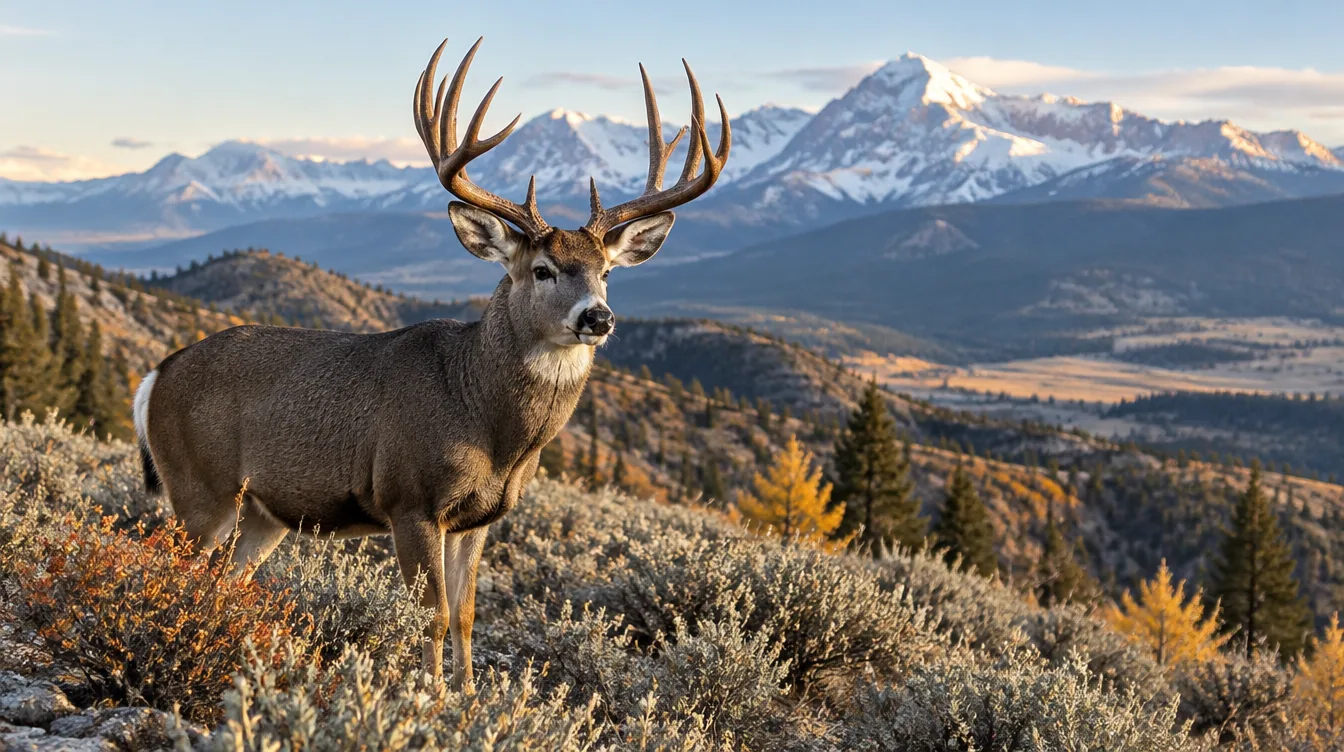
Two hunters, two valleys, one species. Same state, same season, and somewhere behind both of them the same deep gene pool. Yet one comes home with a buck that ends up over the fireplace, and the other eats another tag. You have probably stood in that gap yourself, photo in hand, wondering how a "common" animal can be so hard to find in the size you actually want.
Here is the thing nobody says plainly. Montana's mule deer are common everywhere, but the old ones are not, and the reason is not a secret unit or a lucky tag. It is country. Mule deer are the deer of open, broken, dry ground. The places that grow a five- or six-year-old buck are the places that let an animal live that long without ever being seen from a road. Where you choose to hunt decides more about the size of your deer than how well you hunt.
So the puzzle is not where the giants hide. It is which ground hands a buck the years, the feed, and the distance he needs — and then whether you can get a tag and a boot onto it. That question you can answer with maps, dates, and permission, and this page answers it in that order. Start with what the animal is and where it lives, move to what the trophy permits actually demand of you, and finish with the ground you can really hunt.
The quick facts (Montana mule deer, 2026)
Mule deer run on the same deer and elk framework as everything else in Montana, FWP calls the species "widespread and common across Montana," and every figure below carries its year. Re-verify each against the current regulations before you buy anything.
| Archery season | Sep 5 – Oct 18, 2026 |
| General rifle season | Oct 24 – Nov 29, 2026 |
| Youth deer-only | Oct 15 – 16, 2026 |
| Muzzleloader season | Dec 12 – Dec 20, 2026 |
| Resident tag | General deer license over the counter, $16 ($8 senior/youth) |
| Nonresident tag | Draw a Combination: Deer $760 · Big Game, deer and elk, $1,312 · Elk $1,112 |
| Application window | Mar 1 – Apr 1, 2026; draw results mid-April |
| Deer B | Drawing deadline Jun 1, 2026; many are private-land only |
| Where they live | "Widespread and common across Montana" (FWP Field Guide) |
| Open ground | About 80% of the state is open to general-tag hunting (FWP, 2022) |
| Rough difficulty | Residents walk in and buy. Most nonresidents must draw a Combination, and the marquee mule deer permits are far harder than that. |
Two things about the nonresident Combination are worth settling before anything else. Each one includes general deer and/or elk, upland game bird except turkey, and a season fishing license, so the price buys more than a single animal. And you may hold exactly one Combination per nonresident per year. On top of it, every hunter needs a Conservation License and a Base Hunting License, which for a nonresident adds $10 and $50. You can hunt mule deer and chase elk on one trip, but you cannot split the purchase across two seasons.
Where mule deer live — and where the big ones come from
The FWP Field Guide compresses the whole range into one honest line: mule deer are "widespread and common across Montana." Read that twice, because it says two things at once. There is no region of the state you can write off, since the animal is in all seven of them. And "common" is a statement about the population, not about the animal you are hoping for.
The distinction that matters is country. A mule deer is built for the open: sage flats, prairie coulees, rimrock breaks, and the high basins that sit above the timber. He feeds by sight and escapes by distance, and he will work a long ridge the way a whitetail works a river bottom. That is the whole reason FWP reports whitetails densest in eastern river valleys like the Milk River and in northwestern forested country. The river bottoms and the wet timber belong to the other deer, and the dry, broken, open ground belongs to the muley.
Four things build a big buck, and you can read three of them off a map before you ever drive out. Age is the first, because a mule deer does not reach his heaviest frame and his darkest horn until he is several years old. Feed is the second, and it means the mix of browse, forbs, and agricultural field edges that lets him put on mass instead of just surviving. Cover is the third, and the best cover is not the thickest timber. It is ground broken enough to hide in and open enough to feed in. The fourth is distance from people, and it is the one hunters underrate most. A buck that rarely sees a truck lives longer than a buck that sees one every Saturday of the season.
Put those four together and you have a portrait of trophy country: rough, dry, broken, and lightly traveled. Now read the state against that portrait.
Core country — the western mountains and broken river country. Montana's three western regions hold the steepest, driest, most broken mule deer ground in the state. Region 2, out of Missoula, covers the Bitterroot and the Clark Fork, a long country of dry slopes and deep drainages that is also where the state's hardest mule deer permit lives. Region 3, out of Bozeman, melds that same broken character into the Gallatin and Madison country. Region 1, out of Kalispell, adds the wetter northwest, where mule deer share the ground with the thickest timber and the most whitetails in the state. If you picture a big muley buck on a rimrock point at first light, you are picturing this tier.
The breaks and the prairie — where a general tag does the real work. The eastern regions carry more mule deer hunting than their reputation suggests, and they carry it on a general license. Region 7, out of Miles City, runs the Powder River country, sage and coulee and cottonwood bottom. Region 6, out of Glasgow, and Region 5, out of Billings, round out the east along the Milk and the Yellowstone. Region 4, out of Great Falls, holds the breaks country that spills toward the Missouri. This is the tier where a hunter with an over-the-counter tag and a good pair of boots can spend a whole season learning ground, and where a mature buck in the sage is a real target rather than a fantasy.
A note on the Missouri Breaks, because the folklore runs ahead of the facts. District 700 is named "Missouri Breaks–Prairie" in the regulations, and the country that spans Regions 4 and 6 is genuinely one of the most striking landscapes a Montana hunter can walk into: gumbo bluffs, cottonwood bottoms, and bighorn sheep country as much as deer country. FWP names the Breaks among the state's bighorn sheep ranges and lists HD 482 there. What that country is not, on any source we can point you to, is a documented trophy mule deer destination. FWP has not published a claim like that, so we are not going to manufacture one for you. Go for the access, the country, and the challenge, and read our Missouri Breaks introduction before you plan a trip around it.
And one honest limit, stated up front. We are not going to rank the regions by trophy density. FWP publishes no such ranking, and the people who claim to know one are usually selling a hunt. What you can rank is the country type and the access. Do that, and you will be ahead of most of the hunters in line beside you.
What a "trophy tag" actually means
The East Fork Bitterroot mule deer buck permit is the one hunters whisper about, so it is worth looking at what it actually took to draw it. In 2021 that permit issued 4 tags. Eighty residents holding the maximum 18 bonus points applied, and 4 permits against 80 applicants at the top of the point stack works out to roughly 1 in 20. Those were the best odds that tag offered, and they belonged only to hunters who had already spent eighteen years buying points. Among residents holding zero points, there were 1,334 applicants. One of them drew. That is 1 in 1,334.
FWP's own description of its hardest lotteries is blunter than most hunters would say out loud. The odds of being drawn for many of them, FWP wrote in 2022, are greater than 100 to 1. The East Fork is not an outlier. It is the shape of the whole category.
Bonus points are the tool built for this problem, and they are widely misunderstood, so here is the mechanism in one paragraph. A bonus point adds entries the way extra raffle tickets do, and it is squared before the draw. FWP's own example: ten points becomes (10 × 10) + 1, or 101 entries. You may buy one bonus point per license year per permit type, and the points accumulate until you draw. Parties of up to five may apply together, using the average of their points for a single entry. That smooths a mixed group and does nothing for five hunters holding identical stacks. The math is worth reading closely on our bonus points page, because the squaring is what actually moves your odds and what most hunters get wrong.
So what does eighteen points buy you? It buys the best seat in a room where only four chairs exist and eighty people are standing. Points change your odds. They do not settle your year, and they do not guarantee the tag. The honest reading of the East Fork is that it is a ticket you buy for a decade and might never cash. That is a fine thing to do quietly in the background, as long as you are hunting somewhere real while you wait.
The application machinery for deer and elk is the same. Our walkthrough of applying for a Montana elk tag lays out the timeline, the fees, and the order of operations in plain steps. Read it once and the deer process will look familiar.
The private-land reality
Many mule deer B licenses in Montana are now private-land only, and that phrase does exactly what it says. A B license is generally antlerless, sold by drawing and sometimes over the counter. A resident pays $15 in the draw or $10 over the counter; a nonresident pays $80 or $75. A nonresident Combination holder may add up to two Deer B licenses, and the drawing deadline is Jun 1, 2026. A resident may hold up to three deer licenses in a year, one of them general.
Private-land only means the tag is valid on private ground and nowhere else, which makes the tag worth nothing until you have permission to be there. Montana's permission rule has no soft edge. Every hunter must have landowner permission on private property regardless of whether it is posted, per FWP's own Hunter Access FAQ. Unposted is not open, and a landowner who has never met you is not a plan.
Block Management is the bridge across that gap, and it is the single most useful program for a mule deer hunter who does not own ground. In 2025 it enrolled 1,326 cooperating landowners across 6.81 million acres and paid out $12.5 million. Those figures move every year, so check the current season's number rather than trusting one you read on a forum. FWP publishes its Hunter Access Guide by Aug 15, and our explainer on Block Management covers how sign-in areas and boundaries work in practice.
Three landowner routes are worth knowing about, mostly so you understand why some quotas look smaller than the map suggests. Landowner Preference reserves 15% of a district's quota, and for deer it requires at least 160 acres, primarily agricultural. Landowner Sponsor sets aside 2,000 sponsored nonresident Deer Combination licenses, with a landowner of 640 acres or more able to sponsor up to two hunters. Former Montana residents have Come Home to Hunt, at $380 for the deer license. The quota is 500, in the same Mar 1 – Apr 1 window. Anyone born in Montana can buy the Nonresident Native License at that same price, unlimited and over the counter. All of these routes are real. All of them depend on a relationship or a birth certificate, and relationships take longer to build than points.
The honest picture
Now the part most pages skip, because the Ally's job is to tell you where not to spend your decade.
Do not build your season around the East Fork Bitterroot permit. At four permits and roughly 1 in 1,334 at zero points in 2021, it is not a plan. Buy the bonus point every year if you like, let it ride quietly in the background, and hunt somewhere real with the season you actually hold.
The 80 percent is your opportunity, not your consolation prize. About 80% of Montana is open to general-tag hunting, per FWP's 2022 summary of the license system. That means the great majority of your hunting years will run on a general tag, in country you chose, on a calendar everybody shares. A hunter who learns one drainage of that country over four seasons will out-hunt a stranger who won a permit.
A good Montana buck is not a magazine buck, and that is fine. A magazine-class mule deer is several years old, and getting one takes a mix of country knowledge and luck that most hunters never assemble, and it is worth saying plainly that the photos set a standard almost nobody meets. A mature, healthy buck taken on ground you learned, in a season you planned, that fills a freezer and feeds people you love, is the actual goal. That animal is not a smaller achievement. It is the one you will remember.
Do not confuse "common" with "easy." FWP says mule deer are widespread and common across Montana. That is a statement about the population, and it means the animal is somewhere in every region you might pick. It does not mean you will find a five-year-old buck on opening morning from the truck. It means the odds are in your favor the moment you are standing in the right country, on legal ground, with the wind in your face.
And be honest about the numbers you cannot get. We will not hand you a trophy-density ranking we cannot source, and we will not quote a success rate we have not read. FWP publishes harvest statistics, and if you want to know how a district has actually produced, go to that data rather than to someone's memory of a good year.
If your trip is going to carry two species, the same tag framework covers both. Our Montana elk pillar walks through how the Combination behaves when it has to carry deer and elk at once.
Montana mule deer hunting: questions hunters ask
Do I need to draw to hunt mule deer in Montana? Residents do not: a general deer license is sold over the counter for $16. Most nonresidents do, and they must draw a Combination license, with applications running Mar 1 – Apr 1, 2026, and results in mid-April. The marquee limited mule deer permits are a separate drawing, and a far harder one.
What does a mule deer license cost a nonresident in 2026? The General Deer Combination is $760. The Big Game Combination, which adds elk, is $1,312, and the Elk Combination is $1,112. Each includes upland game bird except turkey and a season fishing license, and each nonresident may hold only one Combination per year. A Conservation License and a Base Hunting License add $10 and $50.
When is Montana's mule deer season in 2026? Archery runs Sep 5 – Oct 18, 2026. General rifle runs Oct 24 – Nov 29, 2026, with a youth deer-only window Oct 15 – 16. Muzzleloader closes the year Dec 12 – Dec 20, 2026. These dates change every year, so confirm them against the current regulations before you book anything.
Are mule deer B licenses private-land only? Many of them are now, though not all. A B license is generally antlerless, sold by drawing and sometimes over the counter, and the drawing deadline is Jun 1, 2026. Where a license is private-land only, it is valid only with landowner permission, so line up the ground before you apply rather than after.
How hard is the East Fork Bitterroot mule deer buck permit to draw? In 2021 it issued 4 permits. Residents holding the maximum 18 bonus points numbered 80, giving roughly 1-in-20 odds at the top of the stack, and of 1,334 zero-point residents one drew — 1 in 1,334. FWP's own 2022 summary says the odds for many of its hardest lotteries are greater than 100 to 1.
Get the numbers before you apply
Everything on this page is a framework. What turns a framework into a plan is knowing the actual deadlines, the actual point math, and the actual odds for the units you are considering in the year you apply.
The Draw Odds & Deadline Calendar puts those figures in one place and keeps them current for the season. It is free, and it is the single most useful thing you can read before you spend $760 on a deer tag. Get the Draw Odds & Deadline Calendar here, then come back and pick your country with your eyes open.